(Editor’s Note: this article was first feature in Sake Today 33, summer 2022)
Shizuoka sake exploded onto the national scene in 1986 when the prefecture shockingly took home ten gold medals at the 1986 National New Sake Competition. That accounted for nearly 10% of the medals taken that year. Prior to that event, some kura sporadically won medals, but nothing ever approached that landmark event. The high quality of ginjō produced from that year on earned the prefecture the nickname “Ginjō Kingdom Shizuoka”. The critical role played by Doi Shuzōjō in this chapter cannot be understated. The key yeast responsible for the prefecture’s rise, now known as HD-1, was isolated at Doi’s kura. Also, its toji at the time, the late Shōkichi Hase (1932–2009), perpetuated his name in the annals of sake lore as one of the “Four Great Noto Toji”. Since then, Doi’s Kaiun brand has consistently ranked among the best of the best, garnering a wealth of medals.
Doi’s kura is snuggled against the base of a densely wooded hill with a small stream burbling in front of its main gate. Cherry trees line the stream making for a very picturesque scene when they are blooming in the spring. The black wooden slats set against the white wall backdrop of the kura give it a historical feel. Its hometown of Kakegawa is a city of about 118,000 in west-central Shizuoka Prefecture. Much of the economy is centered around agriculture with the production and processing of tea making up about 25% of that sector’s revenue. While riding the Tokaidō Line through this area, coiffed rows of tea bushes can be seen on many of the hillside slopes.

It’s here that Yaichi Doi opened the brewery in 1872. He was originally a humble rice farmer who decided to try his hand at making sake. As the area wasn’t a particularly wealthy one, he chose the name Kaiun (meaning good fortune) for his brand in hopes that the business and his neighborhood would become prosperous. Unfortunately, he wouldn’t get to see it achieve anything close to its current level of popularity. The major turning point for the company would take place nearly a century later under the guidance of the fourth-generation president, Kiyoaki Doi.
Kiyoaki was driven to put Kaiun–as well as Shizuoka sake as a whole–on the national map. To achieve this, in 1968 he recruited Hase, then a young toji in his mid-thirties. The two strove to continuously improve on the quality of the brewery’s sake while infusing it with distinct Shizuoka character through the yeast that resided in the kura. Working together with now famed yeast researcher Denbei Kawamura of the Industrial Research Institute of Shizuoka Prefecture, they were able to identify and isolate a particular strain at the kura in 1975. HD-1 yeast produces aromatics that are typically reminiscent of light fruit or melon rather than tropical notes (i.e. isoamyl acetate rather than ethyl caproate), and also results in light-bodied sake with a slightly lower than average acidity. The HD in the yeast name is an acronym derived from the ‘H’ in Hase and ‘D’ in Doi or Denbei (or quite possibly both–accounts differ).
Prior to Hase taking over production, Kaiun was relatively unknown in the Tokyo market. President Doi and Hase sometimes produced daiginjō that they sold to a now-defunct bar in Tokyo called Dengyobō. Patrons there began to inquire as to where such delicious sake was being made. At the time, Doi was really only producing daiginjō for contests, but enough interest was generated that liquor shops began ordering isshōbin (1.8L bottles). Soon there was some media coverage and from that point on, the brewery steadily expanded while making timely investments in upgrades. This led to improved efficiency and before long the sake was selling well. The HD-1 yeast was shared with brewers in the prefecture and the quality of regional ginjō steadily improved, culminating in that watershed year.
Hase had an incredibly successful and consistent forty-year run as toji at Doi while becoming a revered name in the industry. Sadly, he passed away in the summer of 2009 due to injuries sustained in an accident. The current president, fifth-generation Yaichi Doi (named by his father after the founder), says of the former toji, “Hase wasn’t one for flashiness and didn’t speak that much, but he took his sake brewing exceedingly seriously. The lasting impression I have of him is of someone who never raised his voice in anger and dealt with all situations with calmness. He was a gentle man who always expressed a great love for his wife.”
The torch was eventually passed from Hase to one of his understudies, Minori Shinba, and the quality of sake has remained exceptional. While to the consumer, the transition was seamless, for the two men taking over their respective positions, it was fraught with difficulties.

Yaichi took over as president in 2014, something that seemed to be his destiny, especially considering he was given the same name as the man who started the brewery. He was basically raised in the kura and recalls his early years with a few chuckles. “When I was young, about half of our house was the living quarters for brewery workers. I thought at the time that it was normal to have so many adults in the house. It wasn’t until I got older that I realized it was far from ordinary. The brewery workers had been like family to me. They bathed me and gave me sweets. The kura was my playground. I used to climb on the stacks of rice bags, sometimes breaking them and often getting chastised for my behavior.”
Among his family of five siblings (two older sisters, two younger brothers), he was the only one that took an interest in following in their father’s footsteps. As the eldest son in the family he accepted the mantle. Yaichi attended Nōdai (Tokyo University of Agriculture, oft mentioned in our publication), graduating from the Department of Fermentation Science. The normal course of action for the offspring of kuramoto is to study at another brewery or in a sake-related business, such as a distributor, to deepen one’s overall knowledge of the industry. Yaichi opted for a slightly different approach, but definitely one that would broaden his horizons.
“A professor at my university was collecting yeast samples in China. I wanted to follow his lead and do similar work, so I spent a year abroad studying in China. One of my goals in doing this was to gain insight into the market so we could sell sake there. Unfortunately, at the time the name Kaiun was already trademarked in the country, so we couldn’t sell our brand in China.” After a pause he adds, “However, I discovered that that trademark was discontinued five years ago and successfully applied to use it to market Kaiun in China.”
Following his studies, he embarked on a three-month backpacking trip through China, Tibet, Nepal, India, and Thailand. He then returned to Japan to begin his sake career at his family’s kura. For the first three years he diligently brewed and bottled sake in the mornings, then moved to shipping product in the afternoons. After that he gradually took on sales work, rounding out his knowledge of the business. Even now, he can be found working with the brew team early in the morning during the season.
When Yaichi took over as president, the company was still partially using the traditional system of seasonal workers. In an attempt to modernize and also to provide an incentive to attract new employees, he decided to increase employee time off. In doing so, he encountered resistance from the seasonal staff. Describing the difficulties, he says, “At that time the company was split about fifty-fifty, permanent employees to seasonal staff. From the start there was a gap between the two groups. I implemented a schedule in which everyone could have one day off weekly. Even though I increased time off, I tried to keep salaries close to the same rate. But the seasonal staff rebelled saying they didn’t need it. They argued that even if they had a day off, they had nothing really to do. They were so adamant about sticking to the old ways that they all quit and left in the middle of the brewing season! That was around 2016 or 2017. We had a few months left in the season and I was forced to borrow workers from other breweries that had finished brewing or hired part-time employees on a short-term basis. It was really stressful. After that incident, I ceased using seasonal workers and went with all full-time staff. Giving everyone Saturday-Sunday off is nearly impossible, but I am working hard to get everyone on a schedule that allows two days off per week.”

The current brew team consists of eight members. In the past, seven were employed, but in order for everyone to get the desired vacation time, Doi increased the number. He is also aiming to encourage more women to join the team by cultivating an atmosphere of inclusion with flexible scheduling and work assignments.
In addition to a progressive approach to human resources, Yaichi also stresses the importance of environmentalism. To reduce reliance on fossil fuels or nuclear power, the company started using solar power over a decade ago, before it was as commonplace as it is now. Shizuoka has a high annual rate of sunny days and it rarely snows, so migrating to solar was a no-brainer. Currently the grid solar panels covering the warehouse roof generate roughly half of the kura’s energy.
Doi also built its own wastewater treatment facility to dilute the runoff from rice washing before emptying it into the stream next to the brewery. In the past, dumping the untreated water into the river caused it to turn a milky white. As the river is a very important water source for the cultivation of rice, disturbing its natural state and possibly offending his neighbors seemed wrong to Doi, so he commissioned the construction of the treatment facility in order to release the wastewater to the stream in a natural state.

Another goal Yaichi established was making what he calls “Shizuoka-rashi” sake (sake with a distinct profile representative of Shizuoka). He discontinued use of yeast from outside of the prefecture almost entirely, switching to Shizuoka strains HD-1, NO-2, and NEW-5. Though he’d prefer to use local rice, Shizuoka produces a modest amount of sakamai so there was little choice other than to procure it elsewhere. But to highlight Shizuoka-rashi, the brewery uses high-grade, Hyogo-grown rice to make kōji with a lower water content than the norm. This drier kōji dissolves more slowly, allowing increased control over the rate of saccharification so the brewer can keep the flavor less cloying. This method of kōji making was also developed within the prefecture.
Making all this happen is the charge of toji Minori Shinba. Shinba’s mother’s family were sake makers and it was his grandfather that inspired him. He eventually decided to pursue a career in the industry, enrolling at a vocational school in Kyoto to study in genes and biotech. After completing his coursework, he took an 8-5 job at an industrial brewery assisting with the rice washing and steaming processes. After two years he decided that he’d prefer a place that emphasized quality, and one where he could experience the entire sake-making process. An acquaintance familiar with Doi introduced him to the company. Then president Kiyoaki Doi interviewed and hired him in September of 1999. He started that brewing season working under Hase as the person in charge of rice polishing.
Describing his early days learning the ropes he recounts, “I inherited many things from Hase. I came to understand how truly delicious the sake was. Because I was only in my early twenties when I joined, I didn’t have a good concept of the beverage. In the evenings we would all have drinks with Hase Toji. From that, I learned the differences in taste profiles and the deliciousness of sake, but he also taught me the importance of teamwork and wa (unity and the unique bonds formed among the team) during our evening sake circles. Hase didn’t have the time to give me much technical guidance while brewing, but when we drank together, he taught me a wide variety of things.”

Taking over as toji in the footsteps of a legend was a daunting task, but at least he had a decade under his belt working with the master brewer. He says, “Looking back, it was difficult. At the time, we were lacking someone in charge of brewing and there were areas that I wasn’t completely familiar with. I didn’t understand the job of a toji well. But I was so consumed with the constant struggle to finish my daily work that I didn’t really have time to feel the pressure. It was difficult to keep up the frantic pace. When Hase passed away, I didn’t immediately become toji. It was only after an interim period of three years with two workers from Ishikawa acting as co-toji that I took over.”
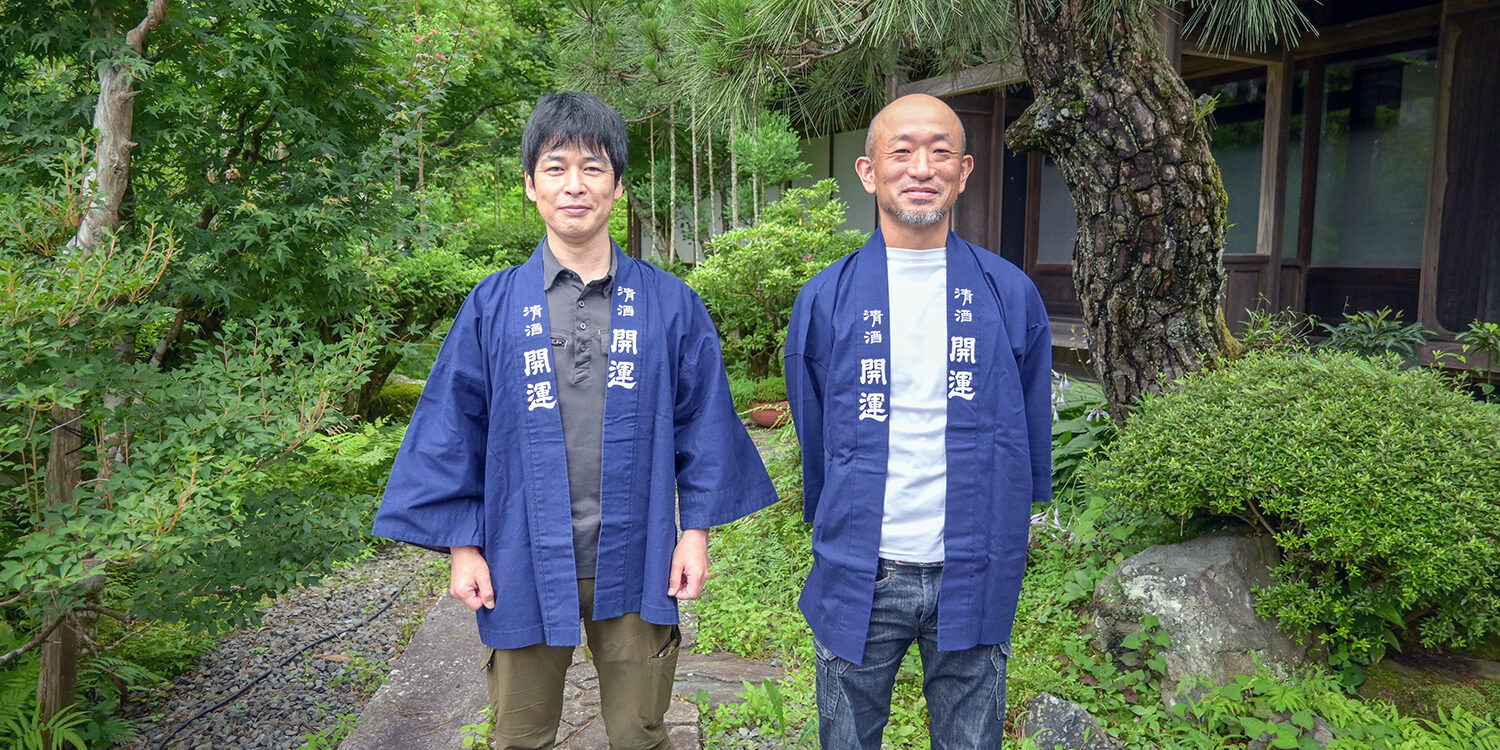
Shinba and Yaichi Doi have since settled into their respective roles. This year they celebrate the brewery’s 150th anniversary. Not only has it played a key role in putting Shizuoka sake on the national map, but now 20% of annual production is exported to over a dozen countries. Original founder Yaichi Doi is surely looking down from somewhere above, smiling at such good fortune. Current president Yaichi will take a few moments to give a nod to his predecessors and acknowledge the kura’s accomplishments. But like any good executive, he is soon mulling over how to navigate the next fifty years.